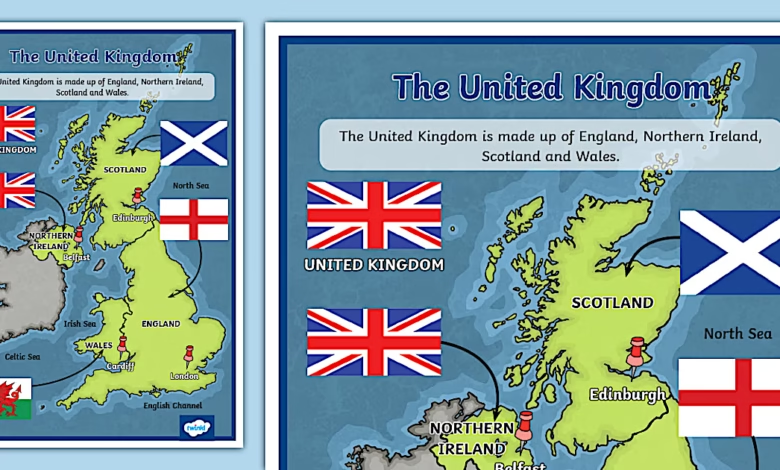
A Map of UK is far more than a simple geographic representation of roads, cities, and boundaries. It serves as a valuable tool for understanding the political, cultural, and physical landscape of one of the world’s most influential nations. Whether used by travelers planning a trip, students studying geography, businesses managing logistics, or researchers exploring regional patterns, a detailed map of the United Kingdom provides essential information about the country’s structure and organization.
The United Kingdom, commonly known as the Map of UK, consists of four nations: England, Scotland, Wales, and Northern Ireland. Each nation has its own identity, history, and unique geographic features. A map helps visualize how these regions connect while highlighting their distinct characteristics. From bustling cities and historic landmarks to mountains, rivers, and coastlines, maps reveal the diversity that makes the UK such a fascinating place.
Modern mapping technology has transformed how people interact with geography. Traditional paper maps have evolved into digital and interactive tools that offer real-time navigation, satellite imagery, and detailed regional information. Despite these advancements, the fundamental purpose remains the same: helping people understand locations, relationships, and movement across space. This guide explores every important aspect of the Map of UK, from geography and administrative divisions to transportation networks and tourist attractions.
Understanding the Map of UK
The United Kingdom occupies a significant position off the northwestern coast of mainland Europe. When examining a Map of UK, one of the first things people notice is its composition of four distinct countries. England occupies the southern and central part of Great Britain, Scotland lies to the north, Wales is located to the west of England, and Northern Ireland occupies part of the island of Ireland.
A common source of confusion is the difference between the Map of UK, Great Britain, and the British Isles. Great Britain refers to the large island containing England, Scotland, and Wales. The United Kingdom includes these three nations plus Northern Ireland. The British Isles is a broader geographic term that includes Great Britain, Ireland, and thousands of surrounding smaller islands.
Maps play an important role in helping people understand these distinctions. Political maps display national boundaries, administrative regions, and major cities, while physical maps reveal natural features such as rivers, mountains, and coastlines. By studying these maps, users gain a clearer understanding of how the Map of UK geography has influenced its history, economy, and culture.
For students and travelers alike, a detailed map of the UK provides a foundation for exploring the country’s many regions and understanding their relationships with one another.
The Four Countries of the United Kingdom
England is the largest and most populous country in the Map of UK. On a map, it occupies the southern portion of Great Britain and contains many of the nation’s most famous cities, including London, Birmingham, Manchester, Liverpool, and Leeds. England is known for its rolling countryside, historic landmarks, and economic significance. London, the capital city, serves as a global center for finance, culture, and politics.
Scotland occupies the northern section of Great Britain and is characterized by dramatic landscapes, rugged mountains, and extensive coastlines. A map of Scotland highlights regions such as the Highlands, Lowlands, and numerous islands. Major cities include Edinburgh, Glasgow, Aberdeen, and Dundee. Scotland’s natural beauty and cultural heritage attract millions of visitors every year.
Wales lies west of England and is known for its mountainous terrain, national parks, and rich Celtic heritage. Cardiff, the capital city, is a vibrant center of culture and commerce. Maps of Wales reveal impressive landscapes such as Snowdonia National Park, which attracts hikers and outdoor enthusiasts from around the world.
Northern Ireland occupies the northeastern section of the island of Ireland. Belfast serves as its capital and largest city. The region is known for attractions such as the Giant’s Causeway and its stunning coastal scenery. Together, these four countries form a diverse and dynamic union represented clearly through any comprehensive Map of UK.
Physical Geography on the Map of UK
A physical Map of UK reveals a landscape rich in natural diversity. The country’s terrain includes mountains, hills, valleys, rivers, lakes, and extensive coastlines. These features have played a crucial role in shaping settlement patterns, transportation networks, and economic development throughout history.
Scotland contains some of the Map of UK highest mountains, including Ben Nevis, the tallest peak in the British Isles. The Scottish Highlands dominate the northern landscape and create one of Europe’s most striking natural environments. Wales is also known for mountainous terrain, particularly within Snowdonia National Park, while northern England features the Pennines, often referred to as the “backbone of England.”
The Map of UK rivers are equally significant. The River Thames flows through London and remains one of the country’s most famous waterways. Other major rivers include the Severn, Trent, Clyde, and Mersey. These rivers have historically supported trade, transportation, and urban development.
Coastal features are another prominent aspect of the Map of UK. Surrounded by the Atlantic Ocean, North Sea, Irish Sea, and English Channel, the nation has thousands of miles of coastline. Cliffs, bays, estuaries, and beaches contribute to the country’s geographic character and tourism appeal.
Major Cities and Landmarks on the Map of UK
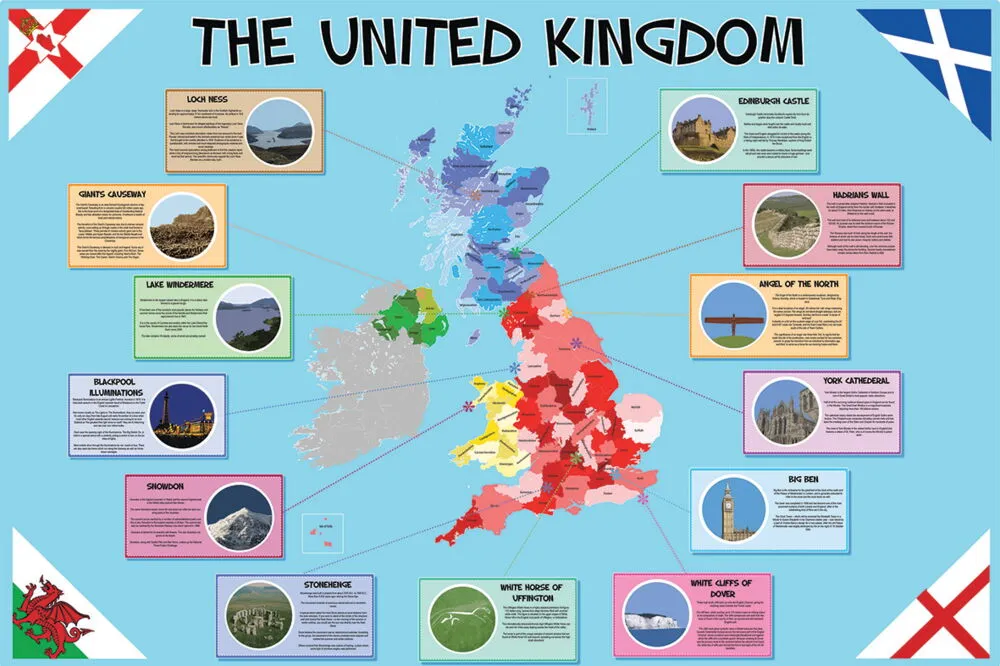
A map of the UK highlights numerous cities that serve as cultural, economic, and political centers. London stands out as the capital and one of the world’s most influential cities. Its landmarks, including Buckingham Palace, the Tower of London, and Big Ben, attract millions of visitors annually.
Beyond London, cities such as Manchester, Birmingham, Liverpool, and Leeds contribute significantly to the UK’s economy and cultural landscape. These urban centers are important hubs for business, education, sports, and entertainment. Their locations on the map help illustrate the distribution of population and economic activity throughout England.
Scotland’s Edinburgh and Glasgow are equally significant. Edinburgh is famous for its historic architecture and annual festivals, while Glasgow is known for its industrial heritage and vibrant arts scene. Cardiff and Belfast also play vital roles within Wales and Northern Ireland respectively.
The UK map additionally showcases world-famous landmarks such as Stonehenge, Edinburgh Castle, Giant’s Causeway, and the Lake District. These attractions contribute to the country’s global reputation as a destination rich in history, culture, and natural beauty.
Transportation Networks Across the UK
Transportation infrastructure is a key feature visible on many UK maps. An extensive network of roads, railways, airports, and ferry routes connects cities, towns, and rural communities across the nation. These systems facilitate travel, trade, and economic activity.
The motorway network forms the backbone of road transportation. Major routes such as the M1, M6, M25, and M4 connect important urban centers and regions. Road maps help drivers plan efficient journeys while understanding regional connectivity.
Rail transportation is equally important. The UK possesses one of the oldest railway systems in the world, linking major cities through high-speed and regional services. Maps of railway networks help travelers navigate routes between destinations efficiently.
Airports such as Heathrow, Gatwick, Manchester, and Edinburgh provide domestic and international connections. Ferry routes connect mainland Britain with islands and neighboring countries. Together, these transportation systems make the UK highly accessible and interconnected.
The Evolution of UK Maps
The history of mapping in the UK dates back centuries. Early maps were often inaccurate and limited in detail, reflecting the technological constraints of their time. As surveying techniques improved, cartographers created increasingly accurate representations of the landscape.
During the medieval period, maps served both practical and symbolic purposes. Later, advances in science and navigation led to more precise cartography. The establishment of the Ordnance Survey in the eighteenth century marked a major milestone in British mapping history.
Today, digital technologies have revolutionized cartography. Geographic Information Systems (GIS), satellite imagery, and GPS navigation provide detailed and constantly updated geographic information. Interactive maps allow users to zoom, search, and customize data according to their needs.
The future of UK mapping will likely involve artificial intelligence, real-time data integration, and enhanced visualization technologies. These innovations will continue improving how people understand and navigate geographic spaces.
Conclusion
A Map of UK is an invaluable resource for understanding the geography, culture, and organization of the United Kingdom. By displaying political boundaries, physical features, transportation networks, and major cities, maps provide a comprehensive overview of one of the world’s most fascinating countries.
From the bustling streets of London to the rugged Highlands of Scotland, from the mountains of Wales to the scenic coastline of Northern Ireland, the UK offers extraordinary geographic diversity. Maps help reveal these characteristics while supporting travel, education, business, and research.
As technology continues to evolve, maps are becoming more detailed, interactive, and accessible than ever before. Whether using a traditional paper map or a modern digital platform, understanding the map of the UK remains an essential skill for exploring and appreciating this remarkable nation.
FAQs
What is a map of UK?
A map of UK is a geographic representation showing the countries, cities, regions, roads, and natural features of the United Kingdom.
What countries are included in the United Kingdom?
The UK consists of England, Scotland, Wales, and Northern Ireland.
What is the difference between the UK and Great Britain?
Great Britain includes England, Scotland, and Wales, while the UK also includes Northern Ireland.
What is the capital of the UK?
London is the capital city of the United Kingdom.
What are the major cities shown on a UK map?
Major cities include London, Birmingham, Manchester, Liverpool, Glasgow, Edinburgh, Cardiff, and Belfast.
What is the largest country in the UK?
England is the largest country by both population and area within the United Kingdom.
What are the major rivers on the UK map?
Major rivers include the Thames, Severn, Trent, Clyde, and Mersey.
What are the most famous landmarks on a UK map?
Famous landmarks include Buckingham Palace, Stonehenge, Edinburgh Castle, and the Giant’s Causeway.
How are digital maps different from paper maps?
Digital maps provide interactive features, real-time updates, GPS navigation, and satellite imagery.
Why is understanding the map of UK important?
It helps with travel planning, geographic education, business operations, research, and understanding the country’s regional diversity.
You May Also Read: Nectarine